
The New Hampshire Wildcats are still chasing the one thing every program wants: a first trip to the Big Dance. UNH is one of the few long-standing Division I programs never to win its conference tournament and reach the NCAAs, and that drought shapes everything about Wildcat basketball. Every February in Durham, the question is the same — is this the year the drought ends?
Nathan Davis enters his fourth season as head coach in 2026–27, and the rebuild is testing everyone’s patience. The 2025–26 Wildcats went 9–21 overall and 5–11 in the America East, tying for seventh in a league that has quietly reshaped itself: UMBC won the conference at 14–2, with Vermont — the long-standing standard-bearer — finishing second at 12–4. Through three seasons Davis is 33–60 in Durham, a record that reflects the difficulty of the job rather than the quality of the coaching.
That’s because Davis has done this before. Before coming to Durham, he won big at Randolph–Macon in Division III — 141–39 with a Final Four and an Elite Eight — and then at Bucknell, where he went 129–115 and took the Bison to back-to-back NCAA Tournaments in 2017 and 2018. He knows exactly what a March-ready program looks like. New Hampshire just hasn’t looked like one yet, not in the conference tournament that matters.
The 2025–26 roster was led by guard KiJan Robinson, who paced the Wildcats at better than 12 points a game, with Jack Graham, big man Belal El Shakery and forward Comeh Emuobor carrying heavy minutes. The scoring was there in stretches — Robinson and Graham combined for a backcourt that could get hot — but the defense couldn’t hold up, and UNH went just 1–10 on the road. In a one-bid league, road losses in January and February are the difference between a seed and a season.
The program’s best modern stretches came under Bill Herrion, who coached the Wildcats for 18 seasons (2005–2023), the program’s longest-tenured leader of the modern era. His teams were consistently competitive — back-to-back 20-win seasons in 2015–16 and 2016–17, winning records in three of his last four full seasons — and his 2023 farewell team went 15–15. But the America East tournament always found a way to break UNH hearts, and the drought outlasted him.
The close calls are the lore: semifinal exits, overtime heartbreaks, and seasons that promised everything and delivered almost. In a one-bid league, the margin between dancing and despair is razor-thin, and the Wildcats have lived on the wrong side of it. The fan base wears it with a gallows humor only New Englanders could love.
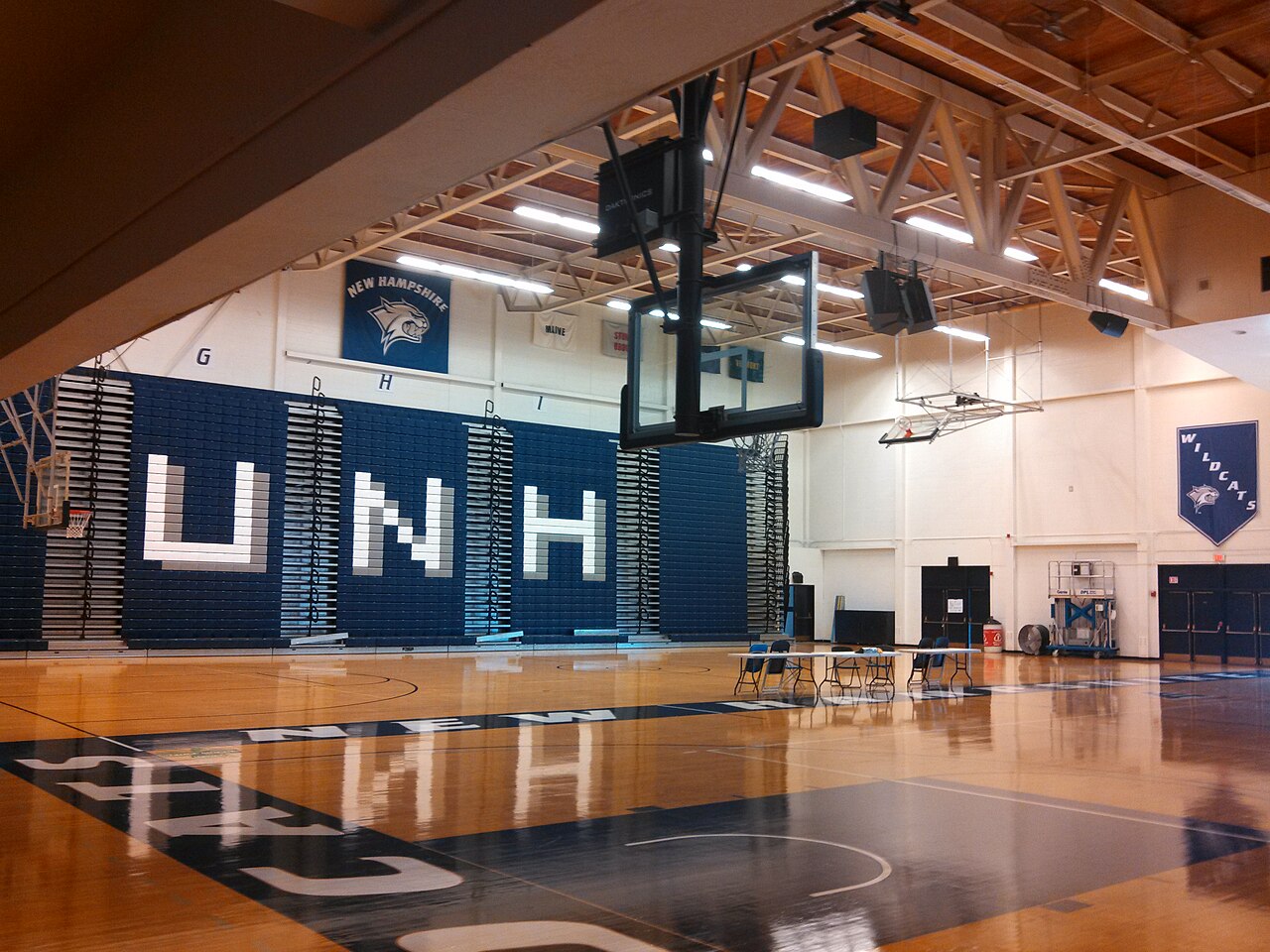
Lundholm Gymnasium remains one of the great small gyms in New England: about 3,000 seats, a low ceiling, and a student section that treats every conference game like the tournament. It’s the kind of building where you can hear every sneaker squeak — and where a conference title celebration would register on the Richter scale. When UNH is good, the building is a fortress.
The Wildcats compete in an America East where the ground is shifting under everyone. Vermont’s generation-long ownership of the league finally loosened in 2025–26, with UMBC — of 2018 Virginia upset fame — seizing the top spot, and NJIT and UMass Lowell crowding the top half. The chaos is an opening: the league is more gettable than it has been in a decade, and all it takes is one hot weekend in March.
The program’s honesty is its charm. There are no banners to polish, no glory days to mythologize — just a group of Wildcats grinding every winter for a breakthrough that would mean everything. In a sport obsessed with blue bloods, UNH is the everyman: no gimmicks, no shortcuts, just the honest pursuit of a first Dance.
What defines New Hampshire basketball is the wait. One of these years, the Wildcats will cut down the nets in the America East tournament, and Lundholm will erupt like nothing the league has ever seen. The drought only makes the first Dance sweeter — and every February, Durham lets itself believe that this is the year.
The stakes of 2026–27 are plain: Davis has the March pedigree — two NCAA bids at Bucknell, a Division III Final Four at Randolph–Macon — and the America East has never been more open. Eighty-eight seasons into Division I basketball, the Wildcats are one of the last long-standing programs still waiting on their first NCAA appearance. Every year the drought grows, and every year the eventual celebration gets bigger. All Davis has to do is survive the February gauntlet and get hot for three days. That’s all it’s ever taken.
The drought won’t end itself — someone has to go take it.