In March of 1988, a small school from the Merrimack Valley cut down the nets in Springfield, Massachusetts. The Lowell Chiefs — led by coach Don Doucette — beat Alaska Anchorage 75-72 to win the NCAA Division II national championship, the single greatest night in program history. Nearly four decades later, that banner is the North Star for everything UMass Lowell basketball is chasing at the Division I level: one more night like that, on an even bigger stage.
The winning DNA runs deeper than one trophy. When Doucette moved on, his successor was Stan Van Gundy — yes, that Stan Van Gundy — who coached Lowell from 1988 to 1992, years before he led the Miami Heat, Orlando Magic and Detroit Pistons in the NBA. Under Greg Herenda the program reached four straight Division II regionals from 2008 to 2011. Lowell knew how to win. The only question was whether it would translate when the school bet on itself and made the jump to Division I in 2013.
The America East handed the keys to Pat Duquette, a Lowell native and former Boston College assistant under Al Skinner. The first years were a transition — ineligible for the postseason while the program climbed from Division II — but Duquette kept building through it. Winning runs in the family: his cousin Dan Duquette ran the Boston Red Sox, Montreal Expos and Baltimore Orioles as general manager. Pat has spent thirteen seasons proving the Lowell version of that family business.
The breakthrough arrived in 2022-23: 26-8 overall, 11-5 in the America East, second place in the league — the best season in program history at the Division I level. Lowell backed it up with 22-10 in 2023-24. The River Hawks had become Vermont’s problem in March instead of a scheduling afterthought, the program’s Merrimack Valley grit — tough, hardworking, defense-first kids the big schools overlooked — translating perfectly to a league owned by the Catamounts.
The 2025-26 season was a step back on paper — 15-18 overall, 9-7 in the league, fourth place — but it produced the closest thing to a March coronation Lowell has ever had. As the No. 4 seed in the America East tournament, the River Hawks defended their home floor, beating Maine 67-56 in the quarterfinals, then went on the road and stunned Albany 81-76 in the semifinals. The run ended in the championship game, a 91-69 loss at top-seeded UMBC. The first Division I Dance remains unclaimed — but Lowell was forty minutes away, on the road, in the final, and the program knows it now.
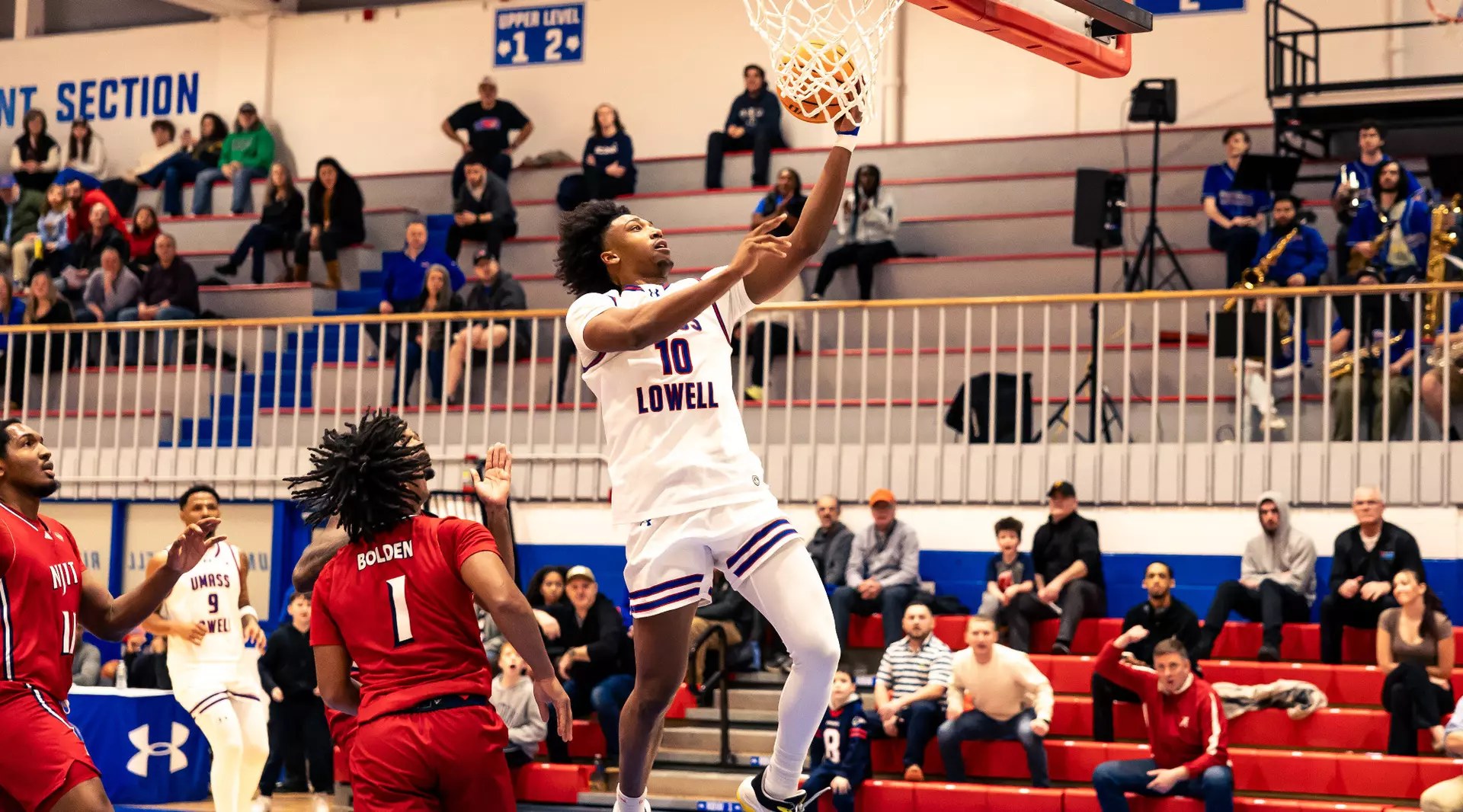
The faces of that run are the program’s next generation. Austin Green led the team at 13.9 points per game, a steady scoring guard; Angel Montas Jr. added 12 a night and went for 18 in a January battle at New Hampshire; Xavier Spencer gave Lowell a presence on the glass, posting a 15-point, 10-rebound double-double in that same game. Guard-driven, physical and unafraid away from home — the Lowell way.
And there is a new home. The Kennedy Family Athletic Complex opened in 2025, giving the program a modern on-campus home to succeed the intimate 2,000-seat Costello Athletic Center — with the 6,500-seat Tsongas Center still in play for the biggest nights. Bricks and mortar are the clearest statement a mid-major can make: we are not going anywhere, and we are done being the league’s afterthought.
The identity is set: in an America East owned by Vermont, UMass Lowell is the spoiler, the team nobody wants to see in March. Rowdy the River Hawk leads the faithful, and the Merrimack Valley’s basketball culture — toughness over pedigree, Lowell pride over recruiting stars — runs through every roster Duquette builds. The breakthrough feels close because it is close: one hot March, one banner, and the 1988 ghosts get company.
Duquette enters his 14th season in 2026-27 with a clear brief: turn the new building into a fortress and finish the climb the last three years started. The semifinal win at Albany proved Lowell can win in March away from home; the championship loss proved there is still one more gear to find. In Lowell, Massachusetts, the belief has not wavered — the River Hawks keep showing up, because one hot March is all it takes. And when it comes, the Tsongas Center is going to shake.
Lowell’s rise has not gone unnoticed around the league. The 2022-23 breakthrough put the River Hawks on the national mid-major radar, and the program has become a destination for New England talent that wants to play meaningful March basketball close to home. In a conference where Vermont has owned the autobid for a generation, Lowell’s emergence as the annual foil — the team with the athletes, the defense and the chip on its shoulder to knock off the Catamounts — has made every America East season more interesting. The rest of the league knows it by now: the River Hawks are not a feel-good story anymore. They are a problem.