
Two seasons ago, Omaha basketball had the best week in school history. The Mavericks won their first Summit League regular-season championship, won their first Summit League tournament championship, and walked into the NCAA Tournament for the first time ever — a No. 15 seed against St. John's in Providence, with the whole city of Omaha watching. They lost 83–53. It didn't matter. For a program that spent a decade learning how to be Division I, it was the mountaintop.
The 2025–26 season was the morning after. At 16–17 overall and 8–8 in the Summit League — tied for fourth — the Mavericks took the step back that so often follows a breakthrough year, when the seniors who made the magic are gone and the target on your back is brand new. Every team in the league circled Omaha on the schedule. Every road gym wanted to be the one that knocked off the champs. The Mavericks fought, but the magic of 2025 didn't repeat. That's not a failure. That's the sport.
But here's what matters: the man who built it isn't going anywhere. Days after the NCAA Tournament loss, Omaha gave head coach Chris Crutchfield a three-year contract extension through the 2029–30 season. “It is an honor to continue as the head men's basketball coach at the school I care about so deeply,” Crutchfield said. “This historic season was incredibly special in unifying our institution, rallying the City of Omaha and showing fans across the country what Omaha basketball and UNO are all about... The best is yet to come for Omaha men's basketball.”
Crutchfield's arc is the program's arc. Hired in 2022 after a long run as an assistant — including time on Dana Altman's staff at Oregon — he inherited a rebuild and went 9–23 in year one. Then 15–18. Then the leap: 22–12 in 2024–25, the Summit League's regular-season crown, the tournament title, the program's first NCAA bid, and Summit League Coach of the Year honors for Crutchfield. Four years, from 10th place to the mountaintop. The extension was the school's way of saying: we know what we have, and we're not letting the portal era or a bigger program take him.
The 2026–27 season is about proving 2025 was a foundation, not a fluke. The Summit League doesn't hand out repeat titles — South Dakota State has owned this conference for a decade, North Dakota State is always lurking, and the league's coaching carousel spun hard in the 2025 offseason — but Omaha now recruits with something it never had before: a banner. Players want to play for programs that win championships and go to the NCAA Tournament. The Mavericks can finally say they do both.
The history here is shorter than most, but it's real. Omaha moved to Division I and joined the Summit League in 2012 under Derrin Hansen, who coached the program for a decade and change — 253 wins, the transition years, the slow climb. The highlights of the Hansen era: an 18–14 campaign in 2015–16, and the 2018–19 team that went 21–11 and 13–3 in the league, finishing second. Those teams proved Omaha could compete in the Summit. Crutchfield's teams proved Omaha could win it.
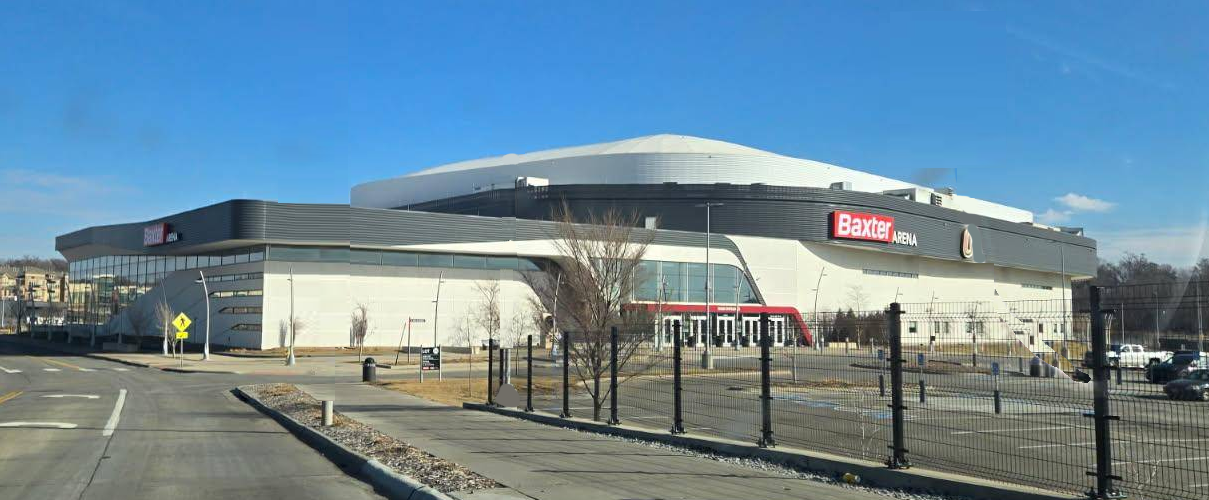
Baxter Arena is the other half of the story. The on-campus building in the heart of Omaha gives the Mavericks one of the Summit League's best home-court settings — and in March 2025, it was the site of a celebration this city had waited its whole Division I life for. When Omaha clinched its championships, Baxter wasn't just an arena. It was proof of concept: a mid-major program, in a hockey-mad city, building a basketball culture from scratch and filling a building to do it. The 2025–26 team went 10–4 at home; making Baxter a place nobody wants to visit is job one for the rebound.
The Summit League math is straightforward and brutal: one bid, winner-take-all in March. Omaha learned both sides of that in back-to-back years — the euphoria of cutting nets in 2025, the quiet of watching someone else do it in 2026. The league sent its champion to the Dance and the rest stayed home, and the Mavericks' 8–8 conference mark left them in the middle of the pack, watching the tournament from the wrong side of the bracket. In this league, the regular season is seeding. March is everything.
What defines Omaha basketball right now is the distance between those two Marches — and a coach, a contract, and a city that all agree on what comes next. The 2025 banners hang in Baxter Arena forever. Nobody can take the first Summit League titles or the first NCAA Tournament away. But Crutchfield didn't sign through 2030 to be a one-hit wonder, and Omaha didn't build a Division I program to visit the mountaintop once. The Mavericks spent a decade learning how to belong. Then they learned how to win. Now comes the hardest lesson in the sport: learning how to do it again.