
There may not be a better story in the mid-major ranks right now than what John Dunne has built in Poughkeepsie. The Marist Red Foxes open the 2026–27 season — Dunne’s ninth — as the Metro Conference’s quietest powerhouse, owners of three straight winning seasons and 57 wins over the last three years, the program’s most since the 2005–08 run. In a league rebranded this season from the MAAC to the Metro Conference, Marist is the team nobody wants to draw in March: elite defensively, disciplined beyond its years, and hardened by the most sustained success the program has enjoyed in nearly two decades.
The 2025–26 campaign was the latest brick in the wall: 19–12 overall, 12–8 in league play, tied for fourth. It wasn’t as shiny as the 20-win season before it, but in some ways it was more impressive — proof that Marist’s winning wasn’t a one-year sugar rush. The Red Foxes did it the Dunne way: they strangled people. Marist held three of its last nine opponents under 50 points; the program has now held 14 teams under 50 in Dunne’s tenure, seven of those in the last three seasons, and forced Niagara into 29.1 percent shooting in a February lockdown. At McCann Arena, opponents shot just .357 from the field and .229 from three while averaging 56.3 points — visiting Poughkeepsie is the Metro’s most miserable road trip, full stop.
The scoring came by committee, which is exactly how Dunne draws it up. Rhyjon Blackwell led the team in scoring eight times, with Elijah Lewis and Justin Menard right behind him; all four of Marist’s leading scorers — Blackwell, Lewis, Menard and Jadin Collins-Roberts — shot a combined 86.7 percent from the free-throw line, each one over 80 percent, which tells you everything about the program’s composure in close games. Jason Schofield, Jaden Daughtry, Tarik Watson, Myles Parker and Parby Kabamba rounded out a rotation ten deep, the kind of depth that lets Dunne play his bruising defensive style for 40 minutes without blinking. Menard’s 17-point night in the February loss to Siena, Lewis’s repeated 20-point outbursts, Blackwell’s steady hand — the Red Foxes never needed one star because they had eight guys who could beat you.
But to understand the moment, you have to feel the 2024–25 season. Twenty wins — the program’s fifth 20-win season ever and its highest total in 18 years. A No. 25 ranking in the College Insider Mid-Major Poll on February 3, the first national ranking in program history. A nine-game winning streak from December 6 through January 16, the longest in 18 years and tied for the fourth-longest in the nation at the time. And Josh Pascarelli, the guard who became Marist’s first First Team All-MAAC selection in 18 years. That team announced to the league that the rebuild was over; the 57 wins since are the receipt.
The climb started the day Dunne arrived in April 2018, and it was a slow one on purpose. He inherited a program that had won 28 games total in the four Mike Maker years, and he rebuilt it brick by brick: 12 wins in year one, the program’s first winning season in 13 years in 2020–21, a six-game winning streak in 2021–22 that was the longest in 15 years. The breakthrough everyone remembers is 2022–23, when Marist won three games in the conference tournament to reach the first MAAC championship final in program history, with Patrick Gardner — who went on to NBA Summer League with the Miami Heat and a contract with the Brooklyn Nets — anchoring the middle. Then came the leap: 18 wins and the No. 3 seed in 2023–24, the program’s best marks in 16 and 17 years, followed by the 20-win eruption. Dunne, who took Saint Peter’s to the 2011 NCAA Tournament and the 2017 CIT title before coming to Marist, knew exactly what a winning mid-major program looked like. He just needed time to build one.
The history he’s chasing is the golden age, and it glows. The Red Foxes’ most famous son is Rik Smits, the 7-foot-4 Dutchman who turned Poughkeepsie into must-see basketball in the mid-1980s and went on to a Hall of Fame-caliber NBA career with the Indiana Pacers. Smits led Marist to back-to-back NCAA Tournament appearances in 1986 and 1987 — the program’s only two dances, the high-water marks every Red Fox team since has chased. The coaching lineage runs through Ron Petro, Matt Furjanic and, longest of all, Dave Magarity, who won 253 games across 18 seasons (1987–2004) and took the 1987 team to the tournament. That’s the standard Dunne is hunting: not just winning seasons, but the March that has eluded Marist for nearly 40 years.
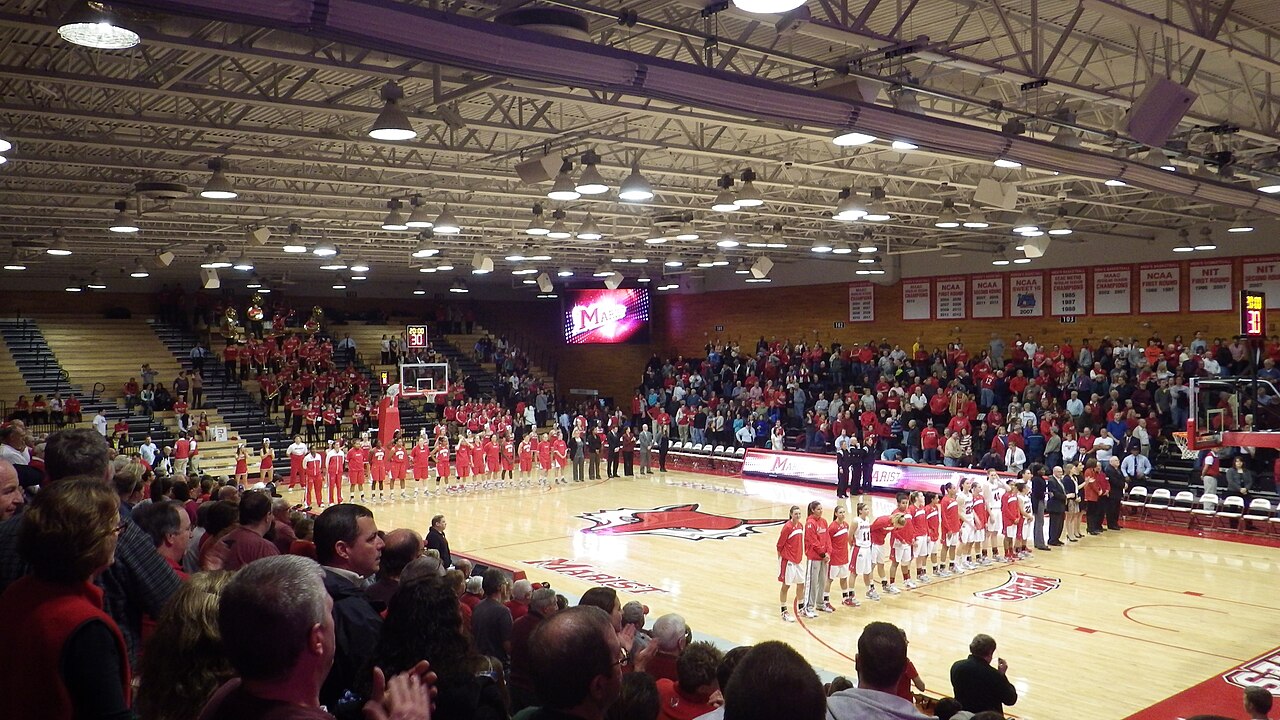
Home is McCann Arena, the 3,200-seat gym on the Marist campus overlooking the Hudson River, and it has become a genuine fortress. Marist went 7–1 at home in 2025–26 with six straight wins, and the building’s personality matches the team: intimate, loud, and suffocating for visitors. The Hudson Valley setting gives the program one of the prettiest campuses in the Northeast and a devoted local following — the Red Foxes are the river town’s team, and the McCann crowds treat every Metro home game like a playoff.
What defines Marist right now is the collision of that history and this present. The Smits-era magic is nearly four decades old, preserved in the rafters and the record books; the Dunne-era machine is right here, right now, winning 19 games a year with defense that travels and depth that doesn’t quit. The one thing missing is the thing that would change everything in Poughkeepsie: a conference tournament title and the NCAA bid that comes with it. The Red Foxes reached the final in 2023 and came up short. They’ve been the league’s best defensive program for three years running. Sooner or later, in a one-bid league, the best team in the building for 40 minutes three nights in a row gets its three games. Marist has never been closer.