
In a transfer-portal era that treats rosters like annual rentals, Fairfield is doing something almost radical: keeping its guys. The Stags came off a 21-13 season — the second 20-win campaign in three years under head coach Chris Casey, capped by a run to the MAAC Tournament semifinals — and instead of watching the portal strip the roster, Fairfield retained the core of the freshman class that started four players down the stretch. “Fairfield is a place where retention is important,” Casey told Mid-Major Madness this summer. “It’s better to recruit the younger guys, recruit the JUCOs, retain them, and develop and grow from there.” That philosophy is the 2026-27 season in one sentence.
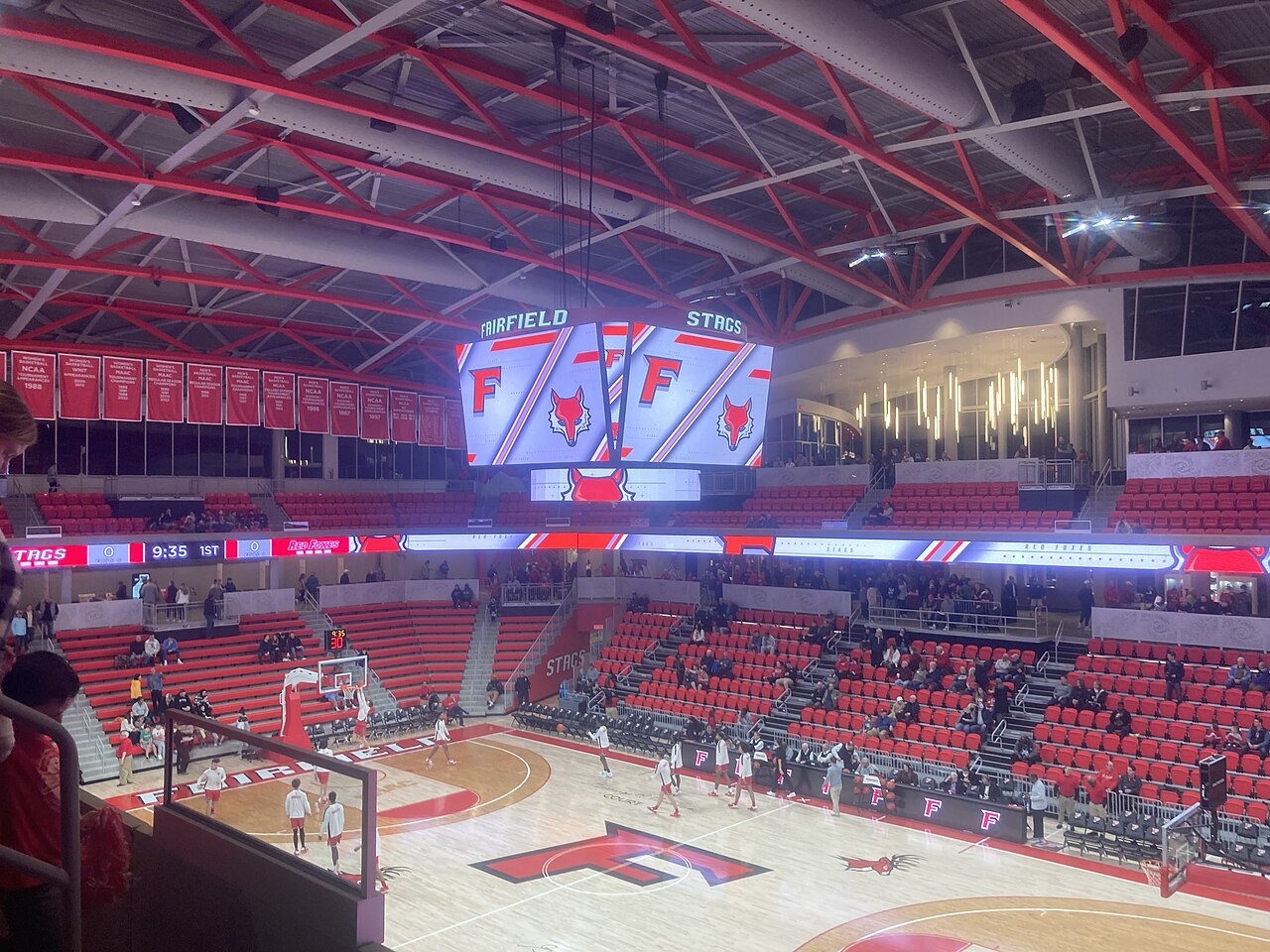
The Stags’ story has always been about the climb. This is one of the MAAC’s proud Jesuit programs, with NCAA Tournament history in 1986 and 1997 and a memorable 2011 NIT run under Ed Cooley that reached the quarterfinals. The rivalries are pure Northeast corridor — Iona, Siena, Manhattan — and the newest chapter plays out at the Leo D. Mahoney Arena, the gleaming on-campus building that opened in 2022 and gave the Stags one of the league’s best home courts. When Mahoney is loud, Fairfield is a problem.
Casey is entering his fourth season in charge — third as the full-time head coach — after taking over on an interim basis in 2023 and earning the permanent job with the way his teams competed. His staff has bought fully into the development model, and last year’s finish — starting four freshmen and winning two postseason games — was the proof of concept. This is a program that knows exactly what it is.
The retained core is the story. Declan Wucherpfennig, the 6-7 Bergen Catholic product, drew two words from Casey when the coach was asked to describe each player in one: “Motor and Winner.” Tony Williams is “Leader.” Eric Mejia is “Physical,” Halon Rawlins a “Winner,” Nasir Rodriguez “Scores.” Around them, the returning veterans — Peyton Smith, the 6-10, 270-pound anchor from Hudson Falls; Isaac Munkadi, the 6-10 Congolese sophomore Casey calls a “Riser”; guards Noah Best, Deuce Turner, Braden Sparks and Cam Estevez — give Fairfield one of the MAAC’s deepest rotations.
The one portal splash is a real one: Marko Radunovic, a 6-6 guard-forward hybrid from Montenegro, arrives after a freshman season at Boston College. Radunovic played professionally for KK Podgorica before coming stateside, and at the U20 European Championship he led Montenegro in scoring and rebounding at 15.9 and 8.6 a game. “A true guard/forward hybrid that can excel in a lot of roles and present matchup problems for defenses at multiple positions,” Casey said. That’s MAAC-speak for: he can guard your best player and score on your second-best.
The supporting cast has texture, too. Qadir Martin brings what Casey calls “Motor.” Brayden Jones is “Physical and Tough.” Oesoemana Sacko is “Talented,” Jah Hatchett “Tough,” Jaden Brown “Talented.” And the final commitment, Louisville guard Cole Edelen, gives the Stags another young ballhandler to develop. Nobody on this roster was rented for a semester. Everybody was recruited to grow.
The MAAC math is simple and brutal. Siena — the league’s standard-bearer — visits Mahoney Arena on Dec. 29. Merrimack comes to town Dec. 6. Quinnipiac and Iona lurk. The Stags don’t need to be the most talented team in the league; they need to be the most connected one. Two years of continuity in a league full of strangers is a genuine edge.
What success looks like: a third 20-win season in four years, a top-three seed, and a real shot at the program’s first NCAA bid since 1997. The Stags’ best basketball should come in March, when a roster that has grown up together meets a tournament full of teams that met in October. That’s the bet Fairfield made — and in the portal era, it’s the bravest bet in the MAAC.
Casey’s teams have an identity, and it’s not subtle: defend, share the ball, and make the other team earn everything. That’s how you win in the MAAC with freshmen — and it’s how the Stags ground out 21 wins last year. The roster is built for it: long guards who can switch, bigs who protect the paint, and a bench deep enough to keep the pressure on for forty minutes. Opponents don’t beat Fairfield with talent alone; they have to beat a system that’s been drilled since October.
And the building helps. Leo D. Mahoney Arena seats just 3,500, and when it’s full it’s a cauldron — students on top of the court, the band shaking the rafters, the kind of intimate noise that makes shooters rush. Fairfield’s history — the 1986 and 1997 NCAA teams, the 2011 NIT quarterfinal run — was built in gyms that felt exactly like that. The Stags don’t need a palace. They need a packed house and a team that plays like the moment matters.