The Pat McAfee Show
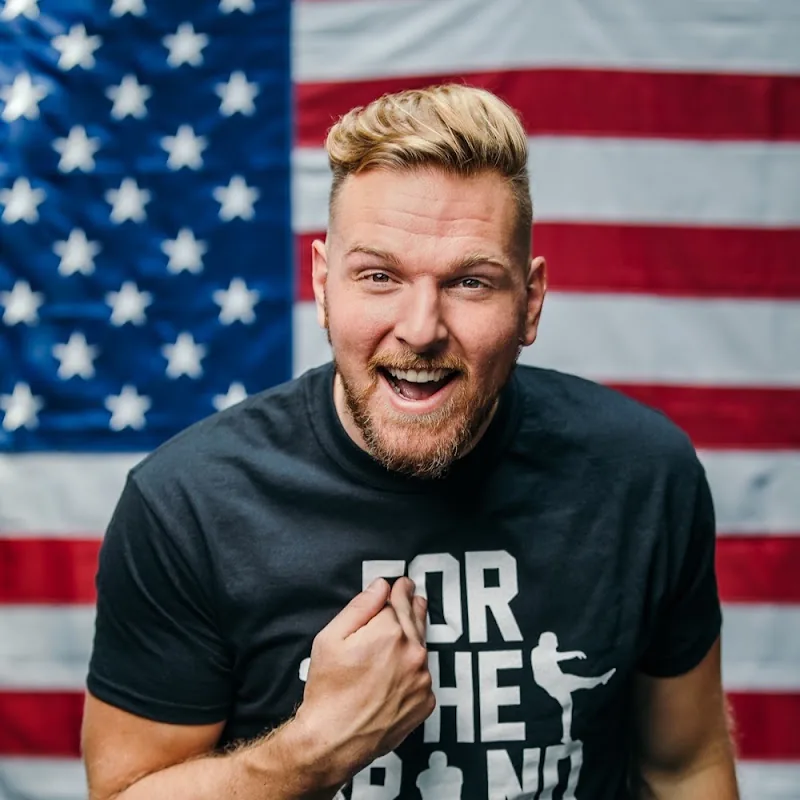
Sports voice · Verified
Former NFL punter Pat McAfee and his crew talk sports every weekday with jokes, guests, and big reactions.
About The Pat McAfee Show
Patrick Justin McAfee was born May 2, 1987, in Plum, Pennsylvania — a Pittsburgh suburb where football is closer to religion than recreation, and where kickers have historically been treated as an afterthought. He was the rare specialist who refused to accept that. An All-American at West Virginia University, he was selected by the Indianapolis Colts in the seventh round of the 2009 NFL Draft, and by the time he walked away from the game at 29, he had become a two-time Pro Bowler, a First-team All-Pro, and one of the most devastating punters the league had ever seen — 575 punts, a 46.4-yard career average, a Super Bowl appearance as a rookie. Then he retired from the only career that had ever made sense, because he had already figured out the next one.
The move from cleats to camera was not a pivot; it was a takeover years in the making. McAfee had been building an audience the entire time he was punting — viral moments, barroom-storytelling energy, a persona far too big for a special-teams meeting room. When he announced his retirement in February 2017, he didn't audition for a network job or wait for a phone call. He started a company: Pat McAfee Inc., and set out to own every inch of what came next.
The early years were scrappy and itinerant. He launched with Barstool Sports in 2017 and built an Indianapolis outpost for the company, but the partnership ended within eighteen months amid disputes over business transparency. Undeterred, McAfee did something few athlete-turned-broadcasters attempt: he kept the show and kept moving the pipes. Under his own banner, the program aired through DAZN, Westwood One radio, and SiriusXM's Mad Dog Sports Radio, slowly hardening from a podcast into a daily television product. The constant through every platform change was the crew — the friends-and-former-athletes ensemble of A.J. Hawk, Tone Digs, Boston Connor, Nick Maraldo, Ty Schmit and producer Todd McComas — whose clubhouse chemistry became the show's signature as much as McAfee himself.
The business bet that changed everything arrived in 2021: a FanDuel sponsorship reportedly worth $120 million over four years, one of the largest endorsement deals ever handed to an independent sports show. That money bankrolled the operation — the staff, the Indianapolis studio, the production values — and proved that an athlete-owned program could command the economics of a network property. From there the trajectory was straight up. McAfee had already been working Saturdays on ESPN's College GameDay, joining the flagship full time in 2022 after a 2019 trial run on Thursday Night College Football. Then, in May 2023, came the landmark agreement: a reported five-year, $85 million licensing deal with ESPN — not a job, a license. McAfee's team still produces the show; ESPN, ESPN+ and YouTube all carry it simultaneously. The structure mattered as much as the money. He hadn't sold the company. He'd rented out the distribution.
The interviews are the proof of concept. "Aaron Rodgers Tuesdays" — the weekly sit-downs with the four-time MVP — turned the show into a functioning newsroom, the place where Rodgers chose to discuss his future, his feuds, and his football. the biggest coaches and players in every sport, the celebrities orbiting the games — they come to McAfee's set because it's fun, and because the conversations feel like the ones athletes have when the cameras are supposed to be off. The stiff shows can't get these interviews. The fun one can.
Running in parallel was the wrestling chapter, which proved the entertainer transcends the sport. McAfee signed with WWE and became a color commentator on SmackDown and later Raw, developing an on-air partnership with Michael Cole that critics genuinely praised. Then he did the unthinkable for a broadcaster: he got in the ring. His in-ring debut against Adam Cole at NXT TakeOver XXX in August 2020 earned real respect from wrestling lifers, and at WrestleMania 38 he beat both Austin Theory and The Miz in the same night — before dropping an impromptu match to Vince McMahon himself minutes later. It was spectacle as business strategy: every WrestleMania moment was another million people learning the name.
The controversies are the cost of the format, and McAfee has never pretended otherwise. In January 2024, a Rodgers segment jokingly suggesting late-night host Jimmy Kimmel's name might appear in released Jeffrey Epstein documents drew a legal threat from Kimmel and a wave of national headlines; McAfee apologized on air while ESPN executives publicly distanced the network from the remarks. Months earlier he had accused a senior ESPN executive of sabotaging the show on live television — calling him a "rat" — then walked it back in a subsequent broadcast. The unfiltered model courts drama; the drama, in turn, feeds the engine. Sponsors and networks keep signing up anyway, because the audience numbers keep justifying the chaos.
Quieter, and just as real, is the charity side. The loudest persona in sports media has spent years turning milestones into money for other people: annual Thanksgiving turkey giveaways in Indianapolis, six-figure charity auctions, fundraisers for fans facing medical crises, donation drives woven into the show's biggest moments. The chaos has a conscience, and the audience that shows up for the jokes shows up for the giving, too.
The daily grind is the part nobody sees. Every weekday, around noon Eastern, McAfee goes live for two to three hours — the stamina of a marathon runner, the preparation of a newsroom, the performance of a stage act — and has done it well past a thousand episodes. In an era when most sports talk is clipped, packaged, and algorithmically optimized, the show remains stubbornly, defiantly live. The takes fly in real time. The mistakes happen in real time. The audience wouldn't have it any other way.
The legacy is the model. Before McAfee, the athlete-media playbook was: retire, wait for the network call, sit behind a desk. After him, it's: own the company, build the audience yourself, license the finished product to the highest bidder. Every former player with a microphone and a podcast feed is now working some version of the McAfee playbook — the authenticity as strategy, the crew as family, the independence as the whole point. The punter bet on himself, and won bigger than anyone in the history of his position ever imagined.
Previously covers The Pat McAfee Show because it is where sports culture's loudest conversations happen first. The show airs live every weekday — the takes are flying, the guests are real, and by dinner the moments have become memes. Sports media's beautiful chaos, on schedule.
Platforms + audience
Every count stamped with its source and date — real numbers only.
Follow The Pat McAfee Show
Official links — we send you to The Pat McAfee Show, we don't pretend to host it.
More on Previously
Where else The Pat McAfee Show turns up on Previously — and where their corner of the site continues.
More like The Pat McAfee Show
Same lane — Sports creators from the hub.

Live reminders are part of Previously accounts — on the full site, signing in turns this on and you'll get a ping the moment The Pat McAfee Show goes live.