The 2025-26 season ended with a thud and a pink slip. UNC Greensboro went 15-19 overall and 9-9 in the Southern Conference, fell 81-75 to Furman in the SoCon tournament semifinals, and days later the school fired head coach Mike Jones — five seasons, a 93-69 record, three straight 20-win campaigns, and it still was not enough. In the SoCon, where one bid is everything, close is the same as nowhere. So the Spartans did what ambitious mid-majors do: they went big.
Enter Jerod Haase. The new head coach arrives with a quarter-century of coaching at the highest levels of the sport — eight seasons as the head coach at Stanford, five at UAB, and assistant stops under Roy Williams at North Carolina and Kansas. His introductory message was blunt and specific: build a national non-conference schedule to harden the team, and turn Bodford Arena — the program’s on-campus home, now the full-time venue for 2026-27 — into an elite home-court advantage. The goal, in his words: play the best basketball in March. Everything else is preparation.
Haase inherits a program with a real identity, not a rebuild-from-scratch. UNCG basketball means defense — ferocious, switch-everything, make-you-miserable defense. That identity was forged under Wes Miller, who built the modern program and took the Spartans to the NCAA tournament in 2018 and 2021, and it was sharpened under Jones: Kobe Langley won back-to-back SoCon Defensive Player of the Year awards in 2023 and 2024, and the 2023-24 team finished 21-11 with the program’s first-ever win over a ranked opponent, a 78-72 stunner at No. 14 Arkansas in Fayetteville. A week later the Spartans won the Baha Mar Hoops Nassau Championship in the Bahamas. That is the standard in Greensboro: guard people, win in November, and be terrifying in March.
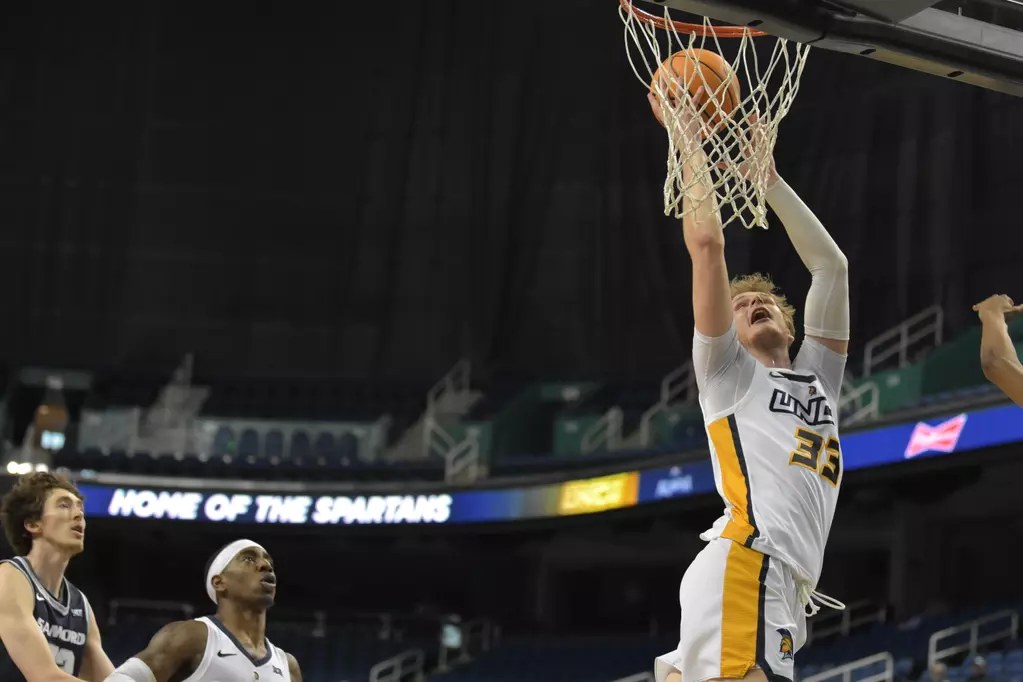
The 2025-26 roster had real talent even in a losing season. Justin Neely averaged 17.9 points per game, made the All-SoCon First Team, was named SoCon Player of the Week twice and earned Lou Henson National Player of the Week honors — the mid-major game’s national spotlight. KJ Younger averaged 15.1 and made the SoCon All-Tournament team after the Spartans beat VMI 84-70 and Wofford 75-72 to reach the semifinals. Donald Whitehead Jr. added 10.1 a night. Three double-figure scorers, a semifinal run — and a coaching change anyway. That tells you everything about the expectations in Greensboro.
The SoCon is one of America’s great mid-major leagues precisely because it is a knife fight: Chattanooga, East Tennessee State, Furman, Wofford, Samford, Mercer — any of them can win Arch Madness-style chaos in Asheville in March. UNCG’s path runs through that gauntlet, and the Spartans’ defensive DNA is built for it. The league’s tournament, played at the Harrah’s Cherokee Center, has been the site of so much SoCon heartbreak that UNCG fans can recite the losses by seed number.
What changes under Haase is the ceiling. Jones was an excellent program steward who won 20 games three years running; Haase was hired to convert that consistency into the one thing that has eluded Greensboro since 2021 — an NCAA bid. His Stanford tenure had its critics, but his UAB teams won and his recruiting networks run deep through the Southeast. The 2026-27 schedule reflects the ambition: 32 regular-season games, a season-opening home date with Milligan on November 3 at Bodford Arena, a Triad rivalry trip to Elon, a West Coast swing through Pepperdine and UC Santa Barbara in late November, and a visit from NC State — a 2026 NCAA tournament team.
Bodford Arena is the other big story. After years of splitting home games between the cavernous First Horizon Coliseum and Fleming Gymnasium, every 2026-27 home game moves to Bodford — smaller, louder, on campus, and exactly the kind of building where a defensive team becomes unbeatable. Haase’s first stated goal is making it a fortress. If the students show up the way SoCon road teams fear they will, Greensboro becomes the hardest ticket in the league by January.
The Spartans have never lacked an identity — blue and gold, defense-first, March-dangerous. What they have lacked, for five years, is the breakthrough. A new coach with power-conference pedigree, a consolidated home arena, and a roster that already knows how to win in March: UNCG is betting that the Haase era is the one that finally cuts the nets in Asheville. In the SoCon, that is the only thing that counts.
Greensboro is a basketball city that deserves a winner — the ACC tournament has called it home for decades, and the Coliseum has hosted Final Fours. UNCG’s rise gave the city its own team to claim, and the crowds for the biggest games proved the appetite is real. Bodford Arena is the bet that intimacy beats scale: a packed on-campus building where the Spartans’ defense can feed off the noise and turn February home games into March previews.