Every college basketball program has a story, but few have one that bends across eras the way Detroit Mercy’s does. The Detroit Mercy Titans are the program Dick Vitale built his legend on and Antoine Davis nearly carried to the top of the entire sport’s record book — a Horizon League outfit from the Motor City whose identity is pure Detroit basketball: tough, loud, and never boring. As the 2026–27 season tips off, the Titans are in year three under head coach Mark Montgomery, still chasing the next chapter that finally turns lore into March hardware.
Start with the lore, because at Detroit Mercy it is genuinely special. Vitale coached the Titans from 1973 to 1977, winning 78 games and taking the program to its first NCAA tournament in 1977, when a 25-win team pushed Michigan to the brink before bowing out. The energy Vitale brought to Calihan Hall — the rolling vowels, the full-court charisma — was Detroit Mercy basketball before it became a national broadcast persona. Five decades later, Titan fans still claim him as their own, and they have every right to.
Then came the Davis years, and nothing about them was ordinary. Antoine Davis arrived in 2018 as the coach’s son — Mike Davis was the head coach — and proceeded to launch one of the great scoring assaults in college basketball history. By the time he finished in 2023, Davis had piled up 3,664 points, second-most in NCAA Division I history, sitting just three points behind Pete Maravich’s immortal 3,667. The “chase for Pistol Pete” became a national obsession that final winter: logo threes, 30-point eruptions, and a 6-foot-1 guard carrying an entire program on his back into the spotlight. Falling just short only added to the legend. Davis also finished as the NCAA’s career leader in three-pointers made, a record that stamped him as one of the purest shooters the game has ever seen.
That is the program’s strange, glorious inheritance: a broadcasting icon and a scoring icon, bookending fifty years of Titan basketball, with the program’s NBA lineage filling the gaps — Hall of Famer Dave DeBusschere, Spencer Haywood, John Long, Terry Tyler and Earl Cureton all wore the red, white and blue. Few mid-majors can point to a deeper professional bloodline.
The present looks very different from the Davis era, and deliberately so. After a 1-31 nightmare in 2023–24 ended the Mike Davis chapter, the school hired Mark Montgomery in March 2024 — a Michigan State graduate, a longtime Tom Izzo assistant, and a man steeped in the culture of winning at the highest level. Montgomery’s mandate was a full rebuild, and year three is the season rebuilds are supposed to start showing. He has recruited the region hard, leaned on the transfer portal for immediate help, and installed the kind of defensive accountability that Izzo disciples are famous for.
The 2026–27 roster is Montgomery’s clearest statement yet about what he wants Detroit Mercy to be. The headliners include senior guard Orlando Lovejoy, an Eastern Michigan transfer with real scoring pedigree. Jared Lary gives the backcourt a veteran ball-handler, while London Maiden — a 6-foot-8 junior — and 7-foot-1 freshman Xavier Istomin-Monroe, the Sydney, Australia product, give the Titans something they have rarely had: genuine size to protect the paint. Young guards Lance Stone, Tyler Spratt and Nate Johnson, plus freshmen like Keshawn Fisher from Overtime Elite, make this a roster built for development as much as the moment.
The Horizon League remains the battlefield, and the wars are personal. The rivalry with Oakland — the Metro Series, two programs separated by about 40 miles of Michigan highway — is the emotional center of every season, and Wright State, Cleveland State and Youngstown State have all taken turns ruling the league in recent years. In a one-bid league, everything funnels toward March: the regular season is about seeding, and the conference tournament is about survival. Detroit Mercy has not danced in the NCAA tournament since 2012, and ending that drought is the stated goal every October.
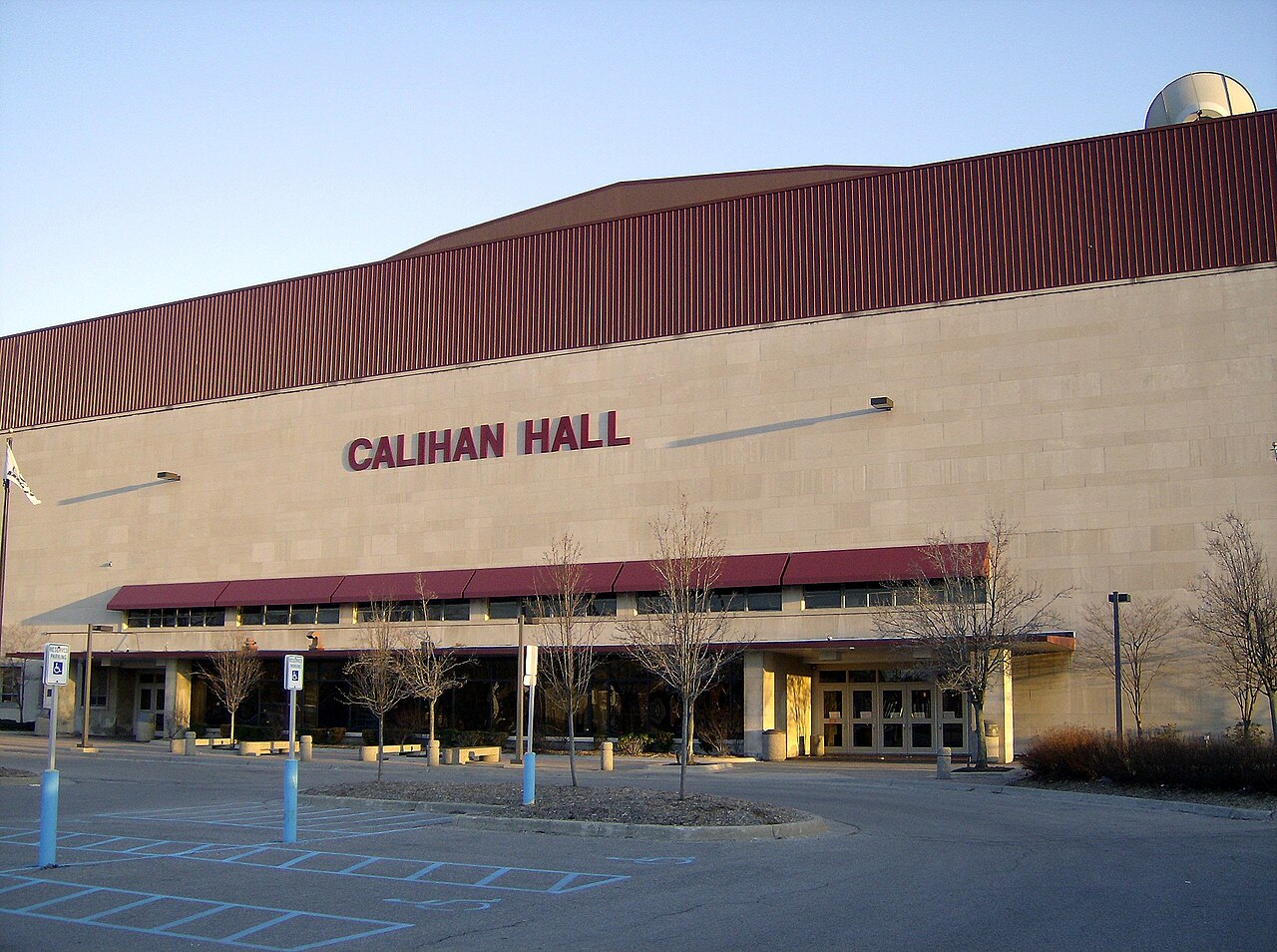
Calihan Hall remains one of the league’s great settings: a 1952 arena on the McNichols campus, intimate enough that the student section feels like it is on the floor, with decades of banners and the echoes of the Vitale years in the rafters. When the building is full — and the Davis chase years proved it can be — there is nothing quite like it in the Horizon League.
What defines Detroit Mercy right now is the gap between heritage and hardware. The program has produced an NBA Hall of Famer, a broadcasting legend and the second-leading scorer in college basketball history — and yet the next March run is still the dream, not the memory. Montgomery was hired to close that gap, to make the Titans matter in March again, and his third season is the referendum. In the Motor City, the soul is never in doubt. Now it is about the substance: winning league games, defending home court, and finally giving Calihan Hall another tournament banner to raise. The Titans’ story is Detroit basketball soul. The next chapter is supposed to be about wins.