When Stan Waterman took over Delaware State basketball in June 2021, he inherited one of the toughest jobs in Division I — a program coming off a 2-26 season with nowhere to go but up. Waterman, a Delaware high school coaching legend from Sanford School whom Hall of Famer Jay Wright called 'an outstanding leader in our game' with 'elite basketball knowledge,' went to work the only way he knows: brick by brick. The win totals rose every single year of his first four seasons — 2, then 6, then 15, then 16 — the kind of steady, honest climb that rebuilds a program's soul.
The high-water mark of the Waterman era so far came in 2023-24, when the Hornets went 15-19 but caught fire in March, advancing all the way to the MEAC championship game — their deepest postseason run in years — and earning an invitation to the College Basketball Invitational, a 16-team national postseason event. The following season, 2024-25, was the breakthrough in the standings: 16-14 overall, 8-6 in the MEAC, a third-place finish. Delaware State basketball was relevant again, and Memorial Hall in Dover had a pulse.
Then came the step back. The 2025-26 Hornets stumbled to 8-23 overall and 2-12 in the MEAC, finishing eighth — a reminder of how fragile progress is at this level, where one thin recruiting class or a few portal departures can undo two years of climbing. There were still moments: a gritty 57-56 win over Maryland Eastern Shore in the MEAC tournament on March 5, 2026, the kind of March survival game that keeps a season from feeling lost. But the numbers told the story — 61.3 points per game as a team, under 40 percent shooting — and in the MEAC, you can't win scoring like that.
Individually, there were players worth watching. Ponce James led the way at 13.7 points per game, an 84.7 percent free-throw shooter who lived at the line. Miles Webb shot 57.1 percent from the floor while adding 9.8 points per night. Corey Perkins, Rahmir Moore, Ademar Santos and Zion Bethea all had their nights, and Camian Shell averaged 9.3 points in limited action. The talent was there in pieces; it just never quite became a team, and the offense never found a second gear.
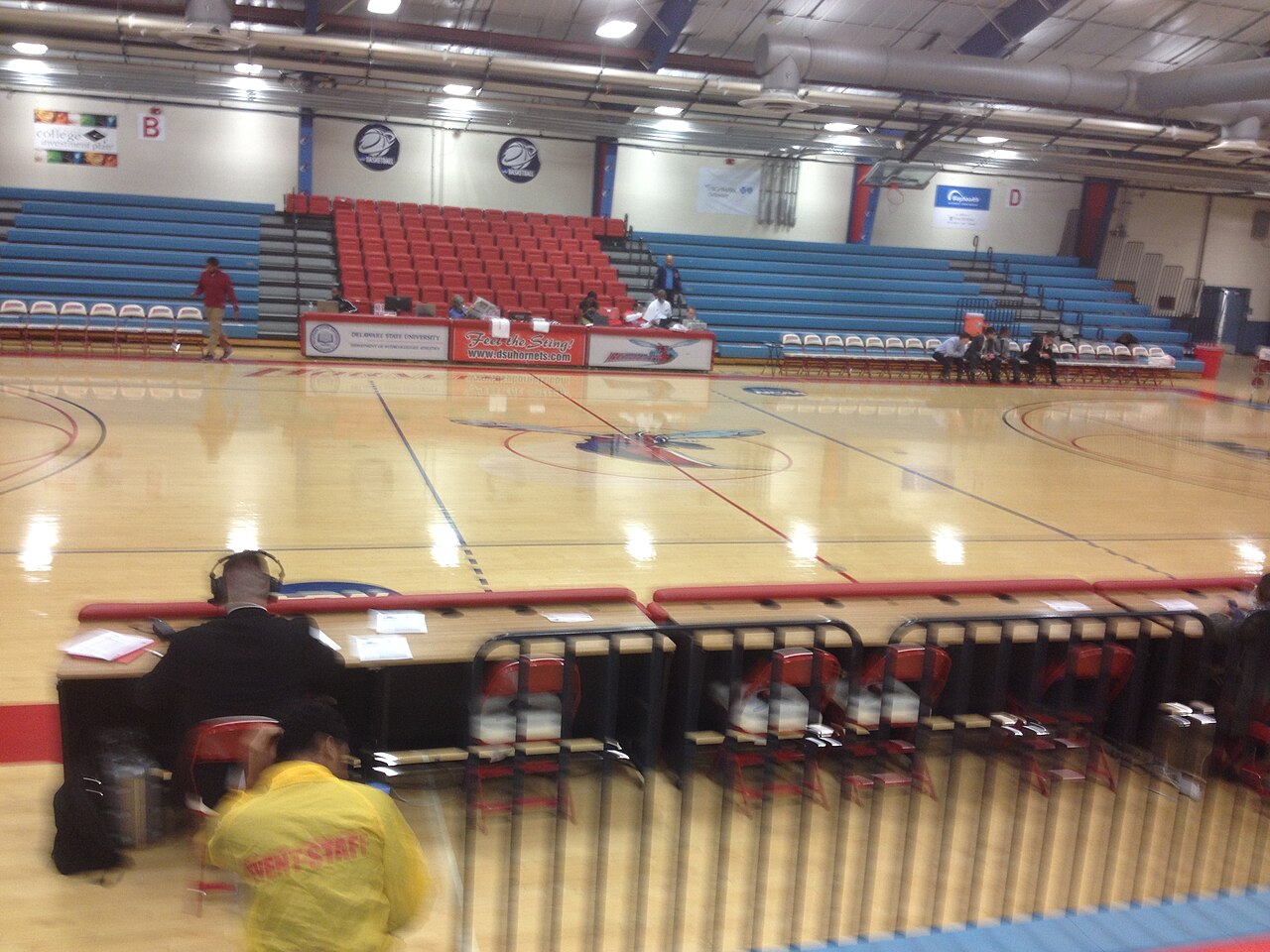
Delaware State's history says this program can be more. The Hornets won the MEAC tournament in 2005 under Greg Jackson and went dancing, drawing Duke in the NCAA Round of 64 — still the program's shining March moment. As an HBCU in the MEAC, Delaware State plays in one of college basketball's most culturally rich leagues, where the bands, the student sections and the rivalries — Howard, Norfolk State, North Carolina Central, Morgan State — make every conference night an event. Memorial Hall, the Hornets' cozy on-campus home, gets loud when there's something to cheer for.
The annual First State rivalry with Delaware is the program's signature nonconference date — two schools 45 minutes apart, one state, one trophy's worth of bragging rights — though the 2026-27 edition won't happen after the schedules couldn't align. It's a series Delaware State circles every year, a measuring stick and a statement game rolled into one, and its absence leaves a hole in the Hornets' November.
Now Waterman enters his sixth season, and the task is clear: fix the offense and get back to the MEAC's upper half. The league remains wide open — Howard, Norfolk State and North Carolina Central have carried the banner in recent years, but the gap between third and eighth in the MEAC is never as wide as it looks. Waterman's developmental track record is the reason for optimism; he has already proven he can take this program from two wins to sixteen. The question is whether the 2025-26 dip was a detour or a warning.
What Delaware State has is a coach who chose this job because he believes in it, a community that showed up when the winning started, and a league where a hot week in March changes everything. The Hornets' story under Waterman is still being written, and the next chapter — the 2026-27 season — is about proving the climb wasn't a fluke. In Dover, they know what the standard looks like now. It's time to get back to it.
The MEAC itself gives Delaware State every reason for optimism. It's a league where the gap between the top and the middle is paper-thin, where one hot shooting week in March rewrites the entire season, and where programs like Norfolk State and Howard have shown that sustained contention is absolutely achievable with the right coach and the right culture. Waterman has already proven the first part — he took a two-win team to sixteen wins and a conference title game. The 2026-27 Hornets don't need a miracle; they need a jump shot, a little health, and the same belief that carried them to that 2023-24 March run. In Dover, the foundation is poured. Now it's time to build on it.