
Levell Sanders calls Binghamton a gold mine, and he means it. The Brooklyn native — a former All-Big East guard at Seton Hall who scored 1,399 points for the Pirates, then spent 15 years playing professionally in Europe — arrived in Vestal as an assistant in 2019 and took over the program in 2021 with a simple pitch: great campus, great facilities, a few hours from New York City, and a community that falls in love with the place once recruits visit. Five years into his tenure, the 2026-27 season is the hinge of the Sanders era — his sixth year as head coach, his eighth overall at Binghamton, and the final year of the five-year contract he signed in February 2022.
The arc so far is one of steady, unglamorous progress. Sanders inherited a program picked to finish last in the America East in his first season and promptly took it to the conference semifinals, producing the program’s highest league win total in 12 years. The 2022-23 team went back to the semifinals and pulled off a tournament road upset at UMBC, 67-65, finishing tied for fourth — the highest America East placement in 14 years. Then came back-to-back 15-win seasons: the 2023-24 squad posted the program’s highest win total in 15 years, won seven of its last 11 conference games and drew more than 2,200 fans a night, second-best in the league; the 2024-25 team produced two all-conference selections and won six of eight down the stretch before a buzzer-beater ended its run at fifth place.
Then 2025-26 happened. The Bearcats were ravaged by injuries — the most season-ending injuries of any NCAA Division I team in the country — and staggered to an 8-23 finish. But even in the wreckage there was a signal: Binghamton won three of its final four games, proof that the culture Sanders had built didn’t crack when the roster did. For a program that has lived through real turbulence, that kind of resilience matters.
And Binghamton has seen turbulence. The program’s greatest high came in 2009, when Al Walker’s Bearcats won the America East tournament and reached the NCAA tournament for the first — and still only — time, drawing Duke in the first round. The aftermath was the program’s darkest chapter: the 2009-10 season collapsed amid a player-dismissal scandal that cost Walker his job and left the program in ruins. Mark Macon and then Tommy Dempsey spent the next decade digging out, and Sanders — hired as Dempsey’s assistant in June 2019, promoted to interim in March 2021 — inherited the long tail of that rebuild.
March is where Binghamton’s season will be decided, as it always is in a one-bid league. The America East tournament sends a single team to the NCAA tournament, which means five months of work come down to three days in March — and the Bearcats have shown under Sanders that they can win on the road when it matters, with tournament upsets in each of his first two seasons. Get a home quarterfinal, survive the weekend, and a program that has waited since 2009 gets its second dance. The blueprint is right there on the wall of the Events Center.
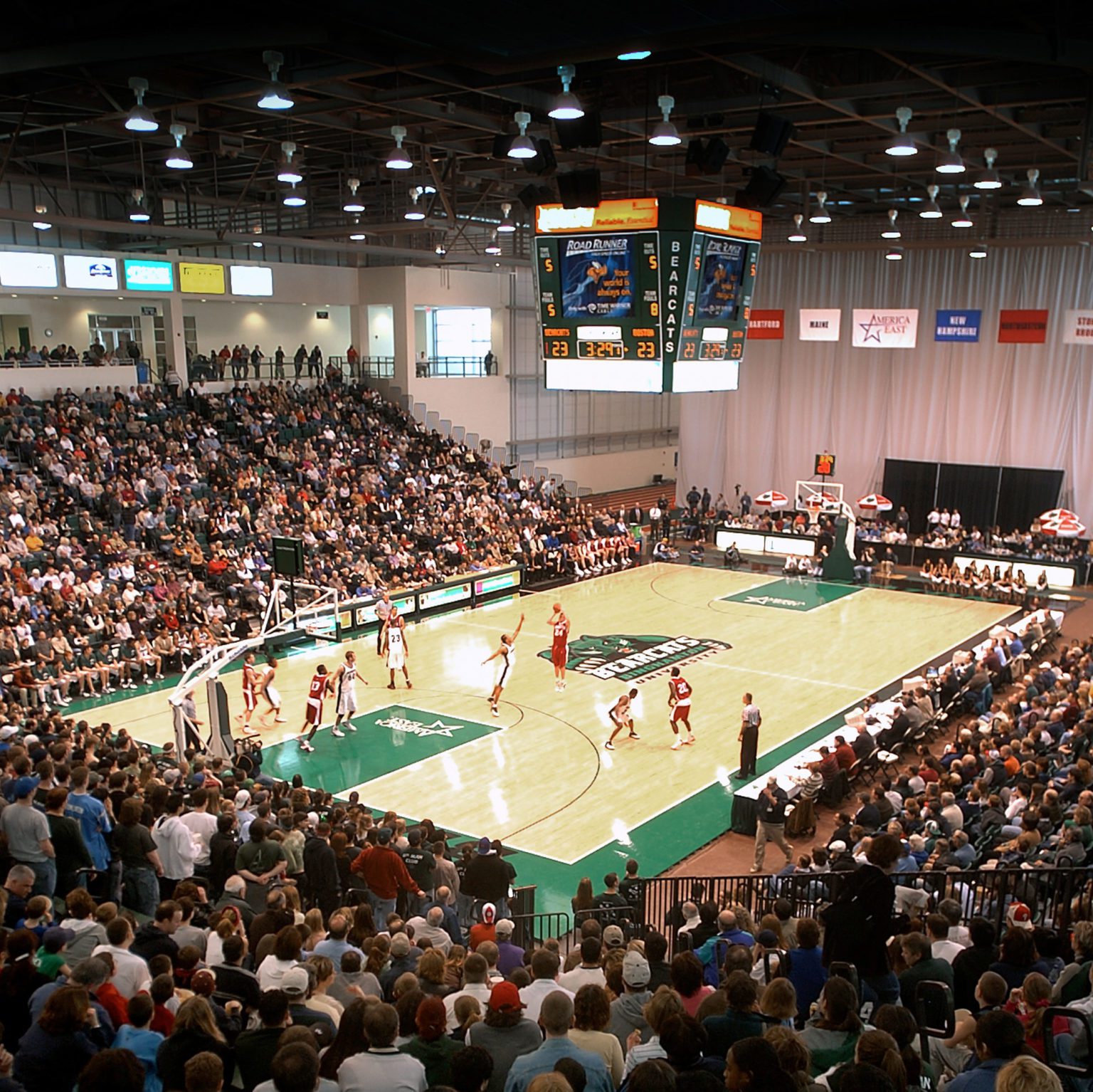
The setting is one of the mid-major world’s underrated gems. The Events Center, opened in 2004 on Binghamton’s hilltop campus, seats more than 5,000 and gives the Bearcats a genuine home-court advantage when it’s full — and it’s been filling up, with attendance ranking among the best in the America East and ahead of 15 other Division I conferences’ averages during the 15-win seasons. Upstate New York winters, a raucous student section and a team that defends its floor: it’s a formula that travels.
Sanders’s teams have a clear identity: tough, disciplined, greater than the sum of their parts. He learned the European game as a player and a coach in the Czech Republic — where he was named Eurobasket.com Coach of the Year in 2017 — and his Bearcats play with a pro’s attention to detail: hard screening, smart shot selection, defense that travels on the road. The program’s first winning conference road record in 13 years came under his watch in year one.
The 2026-27 season carries obvious stakes. It’s the final year of Sanders’s deal, the roster is healthy again, and the Bearcats have shown they can win 15 games and contend for home playoff games in the America East. The league has shifted around them — Vermont remains the standard, but the middle of the conference is winnable every single year. For Binghamton, the goal is the one that has eluded the program since 2009: a second trip to the NCAA tournament, and the validation that the Sanders rebuild was built to last. In Vestal, the gold mine is still being worked.